I Spent 9 Hours Choosing One Font. So I Built FontGrid.
The night one brand project turned into a product, and why seeing your own text in many fonts at once changes the decision.
Sometimes the best ideas do not come from looking for a new project. They come from a problem you live with every day and wish someone had already solved.
I am a graphic designer. For me, typography is never just "picking a nice font". It is a large part of a brand's personality and of how it carries its idea and its feeling out into the world. A logo set in the wrong typeface says something different from the one the client meant, even when every other decision is right.
The part nobody warns you about
Like most designers, I collect. I notice a striking typeface on a shop sign, in a social post, or in a project that inspires me, and I tell myself I will keep it somewhere for the day I need it for a logo or a visual identity.
The trouble was never finding fonts. The trouble was keeping them, organizing them, and being able to explore them when I actually needed them. With thousands of font files installed, choosing the right one started to take far longer than it should.
The night that changed everything
I remember one project clearly. I started looking for the right typeface for a brand identity at 3 AM. I was still looking at noon.
That is about nine hours to choose a single font.
It was not because I could not find good fonts. I found plenty. It was because I could not look at the options and compare them the way a designer needs to. I would open a font, type the brand name, look at it, close it, open the next one, and by the time I reached the tenth I had lost my memory of the first. I was making a visual decision with my short-term memory, and short-term memory is a poor design tool.
There were many tools out there. None gave me what I was after:
- a fast visual overview of many fonts at once,
- simple organization,
- a clear interface,
- and a place to keep the fonts I love.
At that moment I understood that the problem deserved a real solution.
Not another font website
I did not want to build one more site that lists fonts. I wanted a workspace that helps designers do four things well:
- Discover fonts quickly.
- Keep the ones they love.
- Compare the finalists properly.
- Decide faster, with confidence.
So I teamed up with a development team to turn that vision into a product. What surprised me was that the hardest challenge was not adding features. It was making an experience full of capability feel simple.
I wanted a person to open FontGrid, type the text they want to test, and see dozens of fonts in an organized grid, instead of clicking through fonts one by one. I wanted them to save favorites and come back to them without starting the search from scratch.
What FontGrid does today
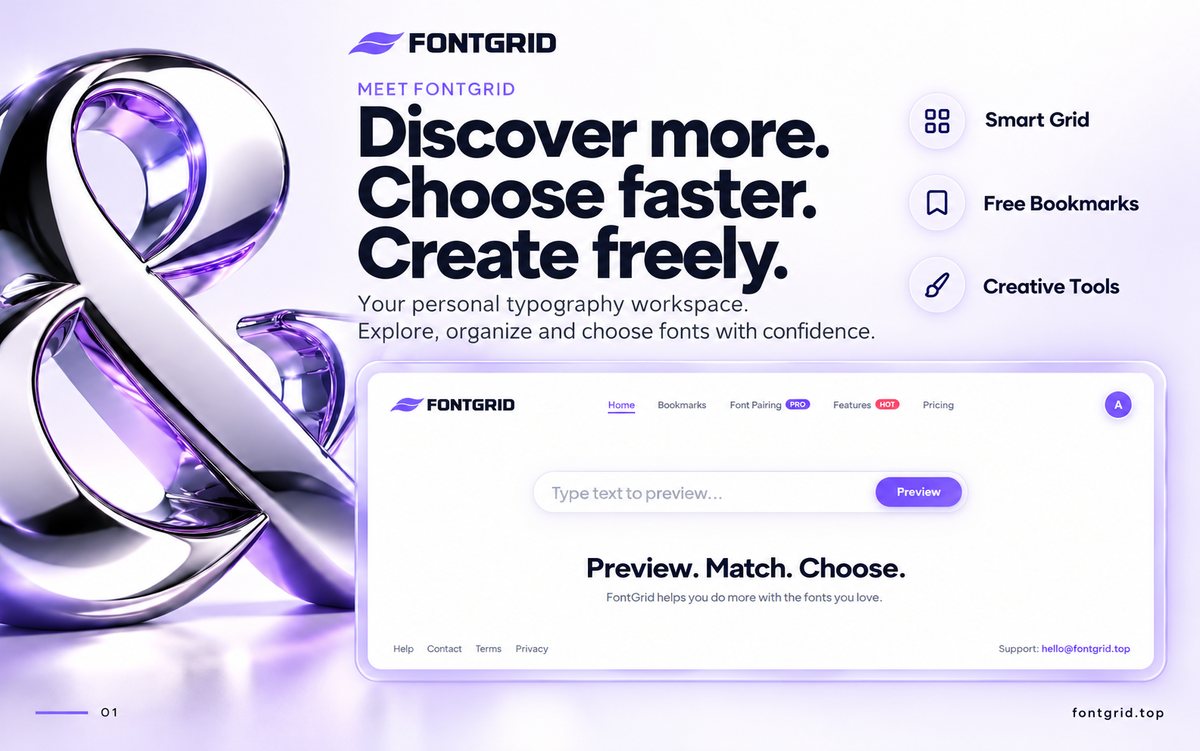
The core idea is the Smart Grid. You type your own words, such as a brand name, a headline or a line of copy, and FontGrid shows them across many fonts at once. Differences that are hard to remember become easy to see.
Around that idea, the product grew in the directions a designer's day actually goes:
- Bookmarks and collections. Save fonts into unlimited, color-coded folders: one for a client, one for a mood, one for Arabic typography, one for your next pitch. These are free.
- Live preview. See your own text, change the size, and judge how a typeface feels with the real words rather than a generic sample.
- Font Compare. Put finalists side by side with the same text.
- Font Pairing. Preview up to five fonts together to test headings, body text and supporting styles.
- Export. Save previews as PNG or JPG to show a client or a teammate.
- A Chrome extension. Preview the fonts on your device straight from the browser, then open the full workspace when you want more.
The free experience lets you preview up to 1,000 fonts available on your device with your own text, on the website and in the extension. Bookmarks and unlimited collections are free as well. Paid plans add the heavier decision tools, with prices set to be reasonable for independent designers and studios.
Why simplicity was the real goal
For me, good design is not the one that impresses you with how many menus and buttons it has. It is the one that lets you finish what you came to do without feeling any complexity.
That is why FontGrid's interface is deliberately calm. The cards are there to show fonts. The controls are there to help you choose. There are no dashboards to learn before you can start, and no extra steps between you and your next idea.
Where this goes next
FontGrid is a real product today, with a website and a Chrome extension. But this is not the end of the story.
My real dream is not only to build a commercially successful product. It is that one day FontGrid becomes one of the basic tools designers, developers and everyone who works with type rely on. I want to save another designer the hours I lost, help them land on a font that inspires them, and give them more time to create instead of search.
I started FontGrid because I needed it myself. I want to keep building it because I know there are thousands of creatives who deserve a better way to choose a font.
Try it with your own words
Take the word you are working on right now, put it into FontGrid, and look at how it changes from font to font. Save the ones that make you pause.
Founder, Ahmed Ghazi